Tuesday, June 2, 2020

Communication Updates, "How to Make Phone Calls and Process Telephone Conversations"

Following my blog of yesterday, where I said that I would bring comments and stories about miscommunication in our everyday life, I will begin with one instance of telephone miscommunication.

Among some telephone messages I got just recently there was one from one of the hospitals we are having to deal with on a health issue my husband is going through at this time.

That particular voice message was very badly executed by the caller. She was a nurse who called regarding some treatments that needed to be done every day. My husband had told the nurses doing the treatment that he would be away for one week, so they would not be expecting him until he returned.

Well when I got the message on my telephone voice mail, the caller spoke in such rapid fire mode that I could not get her name nor the full telephone number – sounds familiar? I'm sure this has happened to you too because I see it all the time.. either by voice message or live telephone conversation. I often have to tell the caller to speak slower... and I mean often.

I get very disturbed that people don't know how to make phone calls and process phone conversation. Many don't even know how to place a phone call.

Here are some etiquette tips to begin with:

1._If you make a phone call, firstly, identify yourself. Don't assume they have your ID on their phone. i.e.: “Hi (name) it's (name)... (if you call from an organization, state that as well”.

2._If you are making the call, be in control. Know why you are calling and tell the person the reason.

3._Get to the point and keep the small talk for after the reason of your call and let the person control that part to a certain point – unless of course you're calling to have a personal chat. Keep control of the conversation and close the conversation when appropriate. Don't assume the person you're calling is in a position to talk, clarify that if you have too, i.e.: “Do you have a minute?”

This is especially important if the person you're calling is in business and has a home office.

4._If you have to leave a message on the voice mail:
a._identify yourself as above.
b._speak slowly, clearly and briefly.
c._leave your name and phone number where to call
d._repeat your name and phone number again before completing your call.

During the process of conversation, speak slowly, pausing after each subject matter to get a response from the listener, and then resume... if the response requires an answer, stay in control of picking up where your were interrupted...

There is yet much more to learning how to handle telephone call where there are many types within personal and business and you can read more about that in my book “Contextual Communication, Organization and Training” available through Amazon.

Successfully Yours,
Diane

Monday, June 1, 2020

Communication, Communication, Communication...

Yes, I know, this triple-mentioned word statement often feels overused. But I remember well the slogan in the real estate business that was coined many years ago "location, location, location" ... it seems very fitting here also to express the importance of communication.

I never run out of new stories about communication and miscommunication that take place in every aspect of our lives, in our everyday living, whether it be on the personal, business and professional level.  I could write about them every day.

Right now, I'm finding myself in a new area of communication and that is within the medical care system. The amount of miscommunication that takes place between doctors and patients and nurses and doctors, etc... and I've been gathering all of that over the last week, having to go through the system as a caregiver to my husband's health situation.

It seems that every day there is some new experience, some new story about the flaws of people communicating to one another.  Even our own communication to others. How many times have you said something to someone only to regret not having clarified a certain aspect about the meaning of what you were trying to relay?

I will be writing about these starting tomorrow as I make a list of those situations I've encountered in the last week and those I seem to be coming across in the daily routines of life. Hopefully we all learn from this and use the knowledge to make things easier for all of us.

Talk to you again soon,

Diane Hoffmann

.


Friday, December 20, 2019

Contextual Communication, Organization and Training

Contextual Communication, Organization and Training
Book -- Revised and Up-dated 2019
by Diane M. Hoffmann


Tuesday, June 18, 2019

Communication Bits -- Answer your emails.

I haven't posted here for a while, but I have been thinking of getting back at sharing again on communication bits that we come across on a daily basis...


Here are 2 recent "Communication Bits" that I came across during one week...


1)
I sent an email to an associate suggesting a possible co-op on a business event to take place on a certain date.
The person wrote back saying it was a great idea, but then said  that he didn't know if he would be in town on that date.
That was his answer.  So I followed-up with another suggested date for the following week.
I did not hear back from him.


2)
I sent an email inviting a business friend and his wife over for dinner, giving them the options for either Friday or Saturday of that same week.  He replied that he had other commitments for both days... and ended the email with "Thanks though".
So as a communication "stickler" (I don't like to call myself an "expert") here is my advice:


For the 1st email:


1. The receiver of the email should have given an alternative date right away on that first response.
Obviously by not doing that, he has to know and realize that the originator of the email will have to follow-up with another question for an alternative date.
And, of course on top of that, the other element of this e-conversation is that the receiver did not even answer the follow-up email at all. That's just plain sloppy email etiquette.


For the 2nd email:


Again, the response from the receiver of the email left the e-conversation incomplete.  He should have said, "I cannot come on either days, but I could make it next week (or whenever)".
Because, again, the original email writer would have wanted to offer another day, if the conversation had taken place in-person. 


In both cases the key is to complete a conversation in one session... otherwise, the conversation will have to be re-initiated again, and always answer personal and business emails.


The Points to take in here:


1. Answer your emails.
2. Answer all your emails completely.

.

Friday, September 8, 2017

The 2Xtremes Analysis

Ok, it's been a while since I wrote a post here. I've been side-tracked by various other projects, but hopefully, I'm back to it again and so, here's another "Tool Within the Tolls" to follow #1 earlier:


TWT #2:
The 2Xtremes analysis

 Often, the indecisions we face are caused because problems fall within the gray areas between black and white and not at either extreme.

If you need further focus on a problem, push the situation to the black or white extreme by asking pertinent questions from these two points of view.

This will identify which side holds the solution or need attention and work. 

 (Sorry for the poor quality, I will re-do the graphic and upload it as soon as possible)

For example you might say: "I won't get that report done on time, so what's the worst scenario that could happen?" 

If it's not that important, you'll be able to make a decision and move on accordingly. If it is important, then you move on to "what's the solution?". Section 7 contains a guideline on solution-finding and problem-solving.

And here is an example of looking at a problem from the 2Xtremes analysis. Have you ever come out of a store or coffee shop and someone else attempts to enter at the same time?

Who has the right of way? Looking at it from the extreme, if the store was full and could not accommodate another person, those entering would have to let people out first and then they could get in. So, based on that, it is a pretty good rule to say that those entering a building should give way to those exiting.

Another way to look at extremes is to look at important people and ask, "What would Einstein do in this situation?" or the Prime minister... "What would Ann Landers say?" Or my father, or mother, or boss, or husband, wife, an admired peer at work, or an expert in the subject at hand -- or you may ask "What would God say?". Then, you can use that extreme to come up with a decision or solution.

Use these tools in preparation for communicating with others. If you find yourself in a communication problem, go "back to the drawing board" and re-do your homework. Try looking at your problem again with these tools and subsequent new information.

Diane

.

Wednesday, August 9, 2017

Tools Within the Tools: The 1-11 Measuring Scale

by Diane M. Hoffmann

For the next while, interspersed among other articles, I will be writing posts on the "Tools Within the Tools (TWT) which I have in my book "Contextual Communication, Organization & Training(c)".

These are tools that we can use to improve our communication in various situations.

TWT #1: "The 1-11 Measuring Scale"

As I say in my book, if 100% is good communication and 50% efficiency and below (which is pretty poor) is what most people communicate at, on a scale of 1 to 11 from one extreme to the other, 1 being 0% and 11 being 100%, we have something like this:


We can use this scale to measure present daily communication habits or scenarios by asking ourselves: "On a scale of 1 to 11, where do I stand as the speaker (sender) or as the listener (receiver), or where does my listener stand?

When faced with a particular communication problem, using this scale, ask yourself: "On a scale of 1 to 11, where does that problem of communication fall between the two extremes?"

This will identify the level of the problem and the equivalent level of corrective action required.

If the problem falls halfway, then ask yourself: "What would the two extremes be if it extended one way or another?" In other words what would be the worst or the best scenario at each end of the scale? This will show what worst destructive or best constructive that could be anticipated.

For example, if the problem of communication you are assessing falls at the 50% level as you candidly assess (you have to be honest with yourself and with others with whom you communicate), then obviously you want it to move from that 50% poor level toward the 100% mark which is good-positive-constructive.

The next question is "how can I improve this communication problem?"

Then, begin to write down various ideas that you can start using.  Many of these ideas are discussed in the book.

The next TWT will expand on the 2 extremes analysis of bad to good./dmh


Cheers and good communication!


Wednesday, June 21, 2017

Good Deeds vs Bad

Benjamin Franklin, once said that it takes many good deeds to build a good reputation, but just one bad deed to lose it.

Everything we do in our daily life is communication. We communicate all the time, whether it be by word or by action.

That's my short post for today -- just a reminder!

Diane

.

Tuesday, March 22, 2016


Improve your Communication Skills series...

Kindle Book series only

 $2.99


.

Wednesday, November 4, 2015

How to deal with change...

Socrates had some good advice for how to deal with change... he said that the secret to dealing with change is to focus on building the new, rather then wasting energy on fighting the old.

Makes sense.


.

Wednesday, March 11, 2015

The Three Levels of Verbal Communication


Here's my tip for today:

The Three Levels of Verbal Communication.

Before we can improve verbal communication and increase its effectiveness, we need to understand how it works and where the players fit within that communication.

First, when we communicate, there is always a sender (speaker or sender) and a receiver (listener or receiver).

Second, the communication itself contains 3 elements:

A) the Information being communicated such as issue, topic, subject, instruction, opinion etc.

B) the Means by which this information is being communicated (verbal, nonverbal, written, using telephone, face to face, letter, book, etc.)

C) the Way in which the information is being communicated (how we use our words, tone of voice, writing style, organized or disorganized manner, etc.)


Both sides have three levels of Active Responsibility to process the activities used in communication:

Level I
is where the actual exchange of communication takes place between the sender and receiver which contains the above three elements.

Level II
is where the Translating and Interpreting of that communication happens. This is done by the thought processes of each the Sender and the Receiver according to each his/her experiences, and frame
of references in their various walks of life (business, personal, moral, ethical, etc.).

This is where the major complications of communication arise (good or bad connection). If everyone thought the same, saw things the same way or reacted in the same manner, communication would be
straightforward.

Level III
is where we get and give Feedback, Understanding and Awareness:.

- Feedback.
Both sides are responsible to see that the communication has been Sent and Received as intended. This is identified by asking the right questions at the right times. "Can you please repeat the steps for closing the shop, to make sure I didn't leave anything out?" "Let me run through the requirements as I understand you've
outlined them". Both sides ask for feedback when needed.

- Understanding.
Effective communication requires a common Understanding between the parties communicating. The Sender Transmits with Understanding to the Receiver. The Receiver Interprets with Understanding from the
Sender.

- Awareness.
Finally, each side requires an Awareness of the interferenres also going on such as cultural differences, linguistics, diction, clarity of speech and expression, verbal, nonverbal parts, etc.


Tip:

All we have to remember about our communication is simply:  the "what" and the "how" :

Level I activities are the "what" elements of our communication (Information, Means, Ways of Sender and Receiver).

 And Level II & III activities are the "how" tools we use in our communication  (Feedback, Understanding and Awareness).


Have a great day.

Diane

P.S.:
Share your thoughts in the comments area of this post.

P.P.S.:
For the Kindle E-book series, please visit this link:
http://communicationverbalnonverbal.blogspot.ca/p/blog-page.html
 

.

Communication Break Downs


Here's my tip for today:

Communication Break Downs

1) Most communication breakdowns happen because of misunderstandings. 

2) And misunderstandings happen when communication is out of context. 

Being aware of the Contextual part of communication is the responsibility to think before sending or receiving.  It means to always bring into the picture the recognition of the immediate surrounding of a given issue or matter being communicated.

When faced with a communication breakdown, the question for us to always ask is this: 

"What is the context of the communication situation I am now in?" 

As in a book where the text is the actual group of words being read, the context is the surrounding information, the details, the story, the places, the characters, etc.

So, where is the conversation within the context of the issue? Is the problem happening  at the sender's end of the communication or at the receiver's end? Where is the misunderstanding? Then focus your communication recovery there.

Communication is never independent of context.


Tip:

First, listen well before you speak.  If you feel yourself getting upset during a difficult situation, take a deep breath, count to 10 or 20 if you have to -- slowly -- before responding. Think about the context of the situation, which should reveal what or where the problem taking place is. Stick to the problem, don't wander off into another issue.

Have a great and wonderful week,

Diane


P.S.:
Share your thoughts in the comments area of this post.

P.P.S.:
For the Kindle E-book series, please visit this link:
http://communicationverbalnonverbal.blogspot.ca/p/blog-page.html
 

.

Tuesday, October 28, 2014

15 Tools to Improve Your Communication Skills

by Diane M. Hoffmann

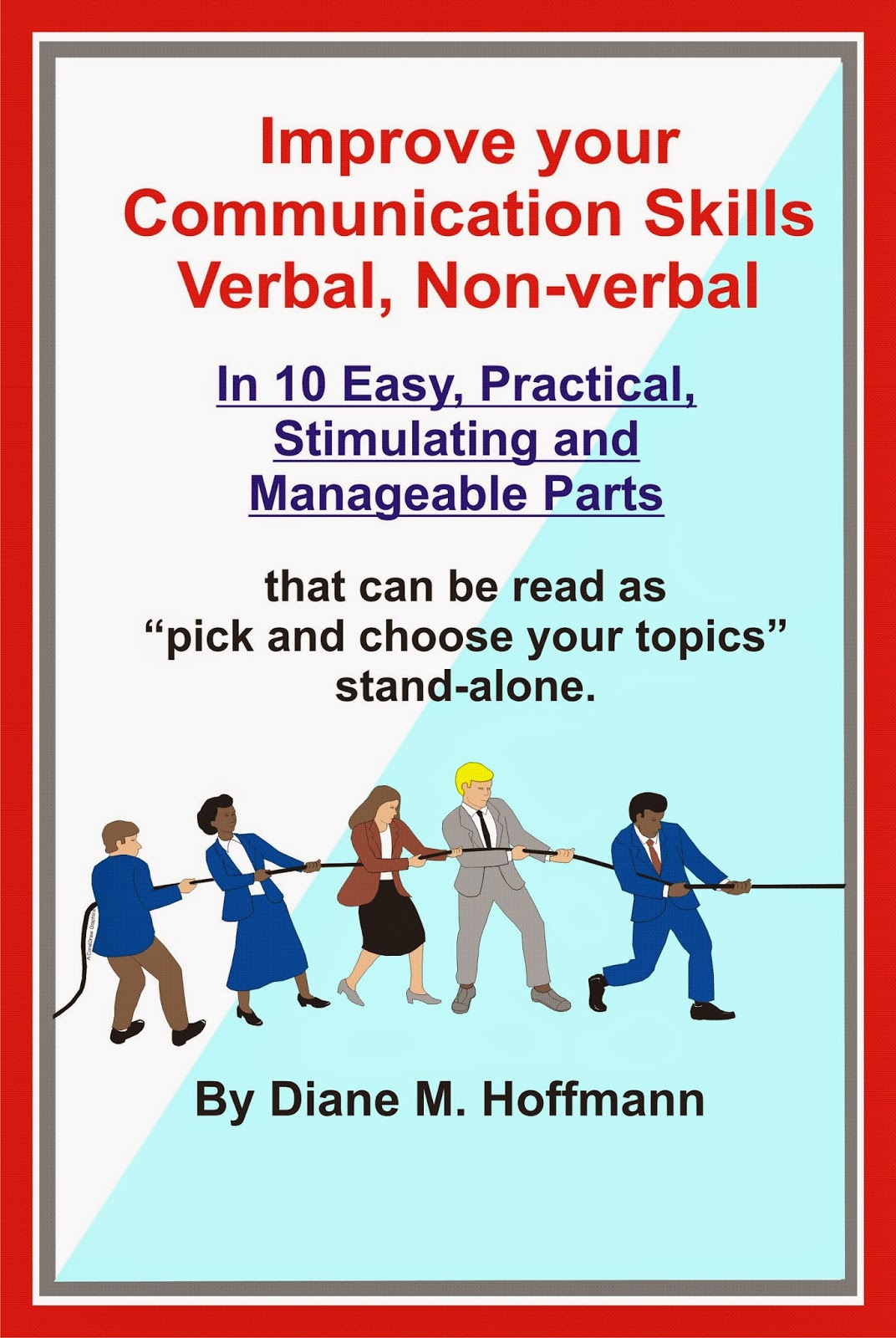
In my book "Contextual Communication, Organization and Training", which is now available in 10 Parts in Kindle book format , re-titled "Improve Your Communication Skills"  I give 15 tools to help you improve your communication skills by 50-100% at home, work or play.

These are tools that I have either created or expounded from existing ones, over the years as I have sought continuously to improve my communication skills. I call them my "Tools-Within-The-Tools".

If you would like to get a copy of the Kindle books where you will find these tools, I've listed the Part # Series that contain them.


For the Kindle E-book series, please visit this link:
http://communicationverbalnonverbal.blogspot.ca/p/blog-page.html


TWT #1:
The 1-11 measuring scale
Use this tool to measure present daily communication habits.

(Found in Kindle book "Improve Communication skills, Part 2&3 combined")

TWT #2:
The 2Xtremes analysis
Use this tool when a problem falls in the grey area that makes it difficult to make important decisions.  

(Found in Kindle book "Improve Communication skills, Part 2&3 combined")

TWT #3:
The 3_D Communication
Use this tool to communicate on a deeper level beneath the obvious surface. 

(Found in Kindle book "Improve Communication skills, Part 2&3 combined")

TWT #4:
The Focus of argument
Use this tool when conversations get off track and need to be re-focused.  

(Found in Kindle book "Improve Communication skills, Part 2&3 combined")

TWT#5:
Smart Questioning 
"Smart" is the key word here to discern the factors that come between the brain and the tongue.  

(Found in Kindle book "Improve Communication skills, Part 2&3 combined")

TWT#6:
The LAC or WAC 
This tool looks at the two kinds of context in communication that deals with improving our thinking before receiving. 

(Found in Kindle book "Improve Communication skills, Part 2&3 combined")

TWT #7:
The Want/Don't Want
Use this tool to analyze how important something is to you or someone you are communicating with. 

(Found in Kindle book "Improve Communication skills, Part 4 combined")
 
TWT #8:
The 360 degree theory
This tool will help you identify where people may be coming from when communication on a specific matter. 

(Found in Kindle book "Improve Communication skills, Part 4 combined")

TWT # 9:
The 1/99 Ratio 
This tool will help to know where people fall within the scale of capability between leaders and followers.


(Found in Kindle book "Improve Communication skills, Part 4 combined")
  TWT # 10:
The 80/20 Ratio 
This is about a further understanding of the application of the famous 80/20 formula, created by the Italian economist Vilfredo Pareto, that affects pretty well every area of life.

TWT # 11:
The 3-3-3 Sounding
Use this tool when faced with a large task or problem to break it down into three category descriptions. 

(Found in Kindle book "Improve Communication skills, Part 4 combined")

TWT # 12:
The 4-P
Use this tool to help identify the personality types of people you are communicating with. 

(Found in Kindle book "Improve Communication skills, Part 5 combined")

TWT # 13:
Enthusiasm 
This is one of the most effective sales tools available to a salesperson, whether you are selling a product in a business or yourself in your personal every day life.

(Found in Kindle book "Improve Communication skills, Part 6 combined")

TWT # 14:
The 7-Points Problem Solving
This tool shows seven questions to ask yourself within the solution rather than the problem area of situations that need corrective actions.

(Found in Kindle book "Improve Communication skills, Part 9 combined")

TWT # 15:
The 3-Groups Letter Writing
Writing has changed enormously from the old days to now. This tool will simplify the dreaded letter writing - email or otherwise - into three simple groups that get to the point whether in business or on the personal level. 

(Found in Kindle book "Improve Communication skills, Part 10 combined") 


Success and Blessings,

Diane


P.S.:
Share your thoughts in the comments area of this post.

P.P.S.:
For the Kindle E-book series, please visit this link:
http://communicationverbalnonverbal.blogspot.ca/p/blog-page.html


.


Life is all about communicating with one another

It doesn't matter what area of life, whether it is our simple individual life, family life, society, local, municipal, regional, national, global – it's all about communicating with one another.

Let me begin with an example of a local situation...

I'm always amazed at how bad people are at communicating and/or at realizing how they communicate with others.

For instance, I like to help people. I give a lot of my time to volunteer activities in various organizations, etc.

One of the things that I often see is that when someone offers their services for free (volunteer) to an organization, they are often – too often – received nonchalantly (indifferently, detached, unappreciatively). And then they wonder why they have a hard time getting volunteers.

Case in point:

I joined a seniors group some time ago.  After hearing they needed some help in a particular up-coming event, I went up to the activity organizer and offered to help out. The woman brought me to the person who is supposedly in charge of that event and who would show me what I needed to do, etc.

She told me to be there at 10 am on the day of the event, the following week.  So I scheduled this time on my busy calendar and showed up on time (5 min. earlier as I usually do – another communicating issue I'll talk about next).

I looked for her and didn't see her around. I then checked with the receptionist and she told me the lady wasn't in and whe didn't expect her until 11.  So I indicating that I was asked to be there at 10 and had put that time from by business aside for them. She told me to talk to another person, pointing to the vice-president of the organization in the center of the hall.

So I proceeded toward her who was at this time totally immersed in a hot discussion with a senior member.  I waited, and waited, trying to get her attention, but she wouldn't budge. After about 10 minutes of this, I left, letting the receptionist know that I would try and come back later.

Of course, my time being money, I never go idle for long, so I proceeded to do some business while I was in that area. One thing led to another which got me into other issues and next thing I knew I was back in the office taking care of pressing matters that followed. So, I never did get back to them, but had they been there as planned, they would have had my time for a couple of hours of my business time given to them for free.


Have a great day,

Diane


For the Kindle E-book series, please visit this link:
http://communicationverbalnonverbal.blogspot.ca/p/blog-page.html


Wednesday, September 17, 2014

Meetings and Communication – Know What Your Meeting is About.


In meetings and communication, know what your meeting is about.

There are basically 3 types of meetings: Informational, Problem-solving and Idea-generating.

You might say, "Well, my meeting is about Safety Regulations". OK, but is it Safety Regulations Informational? Safety Regulations Problem-Solving? Safety Regulations Idea-Generating?

If you have all three under the same meeting, write your Agenda as: 5 minutes Information, 10 min. Problem-Solving and 15 minutes Idea-Generating, or whatever -- that's why preparation is necessary, these things must be determined ahead of time.

All meetings must be short -- in and out in 30 minutes! Some meetings will need 1 hour, of course, but this should only be when absolutely necessary and fewer and farther apart. A rule of thumb is the longer the meetings, the fewer they are; i.e. weekly meetings: 30 minutes or less. Montly or quarterly meetings could go to 1 hour or 2. Semi-annual, 2-3 hours or ½-day. Yearly meetings, such as conventions, 1 day.

They should be well planned ahead to get to the point fast and to stimulate discussion. The discussions must be well defined, i.e.: "For the next 15 minutes, we will talk about the current annual Sales Goals." "Now for the next 15 minutes, we will discuss the Salary Structure."

List them on the agenda so the people can follow clearly. Lead to get the results you plan or expect and to stay within the time frames allotted, if you cannot achieve this on any one item, move it to another meeting. Be in control!

Meetings are terrific opportunities to get communication flowing among the people. Bring some donuts, be positive, get to the point. Move fast. Let them leave the meeting fired up -- not dragged down. All the while, you are training others to do the same!

Failure to control meetings is a demonstration of mismanagement on the part of the individual doing the meeting and the whole corporation behind him or her. 


.

Meetings and Communication – Preparation is King!


In meetings and communication, preparation is King!

In the previous blog we saw the director of a large company department call out a meeting and then show up late “because he had forgotten!”

Then, what happened next is even more amazing. The director began to pull out the slide projector from the back of the room, fighting his way through the crowded area. He finally got it plugged in, turned on the light and placed the first slide of the new organization on, but nothing showed up on the wall.

Realizing the projector was on backward, he struggled some more to get it right, etc. This is a true story in a world-class company and that individual was the head of that gathered department.

Some people believe that arriving late at a meeting is a sign of importance. No, it's not. And it's not a manipulative tool to show how big one is. We earn our respect by being on time, by respecting other people's time. It is not fair to those who have been invited to attend, and who have phone calls to make and work to do. Continuous training is done by our behaviour, by being efficient in our roles as managers.

Then we have those who think that running late at every checkpoint of a meeting is also a sign of "bigness". Well, it is only a sign of disorganization, sloppiness or not being in control. And, the best way to discourage people from coming to your meetings is to do just that. On the contrary, if you finish a couple of minutes earlier... there will be excitement and appreciation, and people will not be afraid to come to your meetings again.

Any kind of meetings, be it seminars, sales presentations, workshops, conventions -- must commence and end at the pre-determined and announced time. They must be on target with the agenda, and fast-moving.

First, there must be an agenda -- never have a meeting without one. It should outline briefly why the meeting is being held, what the goal or result is expected to be, and it should break down the subjects and activities in 5- or 10-minute increments.

And this requires preparation ahead of time.

There are basically 3 types of meetings… we will look at them in the next blog.


.

Meetings and Communication – Short and On-Time!


Meetings and Communication should be short and on time!

"Holding meetings" is a misunderstood concept. When we say that regular meetings are necessary for effective communication, it does not mean that one has to find extra days to fit them in. This is why many managers don’t like meetings.

Most meetings waste more time than they should. Why? Because they are not planned properly. The majority of meetings in companies could be cut by 50%. The presentations are usually too long, move too slowly and contain redundant material.

In writing, the key to good writing is "edit, edit, edit -- each time slashing off 20% until there is nothing to slash off any more. In the same way presentations for meetings should be prepared.

What normally happens in companies is the one calling the meeting goes over the scheduled time; there is no justification for that, no matter how one makes it out to sound. A meeting that goes beyond its announced time at any point, simply means the one holding the meeting has no control of it and has not prepared for it.

Meetings must be kept on schedule. They simply must! Even for bosses. Some time ago, I was present in a department meeting that was called by the director of a large department. People gathered in, the group built up in numbers, but the director didn't show up. After some fifteen minutes, people started to ask what was going on and the secretary went out to make a phone call. She returned to say that he was on his way.

When he arrived he simply said that he had completely forgotten. Where do they get that? They read somewhere that they should be honest and truthful with their people -- problem is these things are taken and practiced out of context.

Yes, the new management style is to be honest and truthful but this means with appropriate behaviour -- in this case, we have to make sure we're on time for our own meetings as managers. Saying you forgot you had called a meeting is not a way to lead by example and train people.

Here were twenty-some people being trained that you can be late for meetings and it doesn't matter, all we have to say is "I'm sorry, I forgot".

That’s the first lesson… in the next blog, wait and see what happened next!


.

Meetings and Communication – “Regular” is the Key


In meetings and communication – “Regular” is the Key.Often, the remedy for many problems in miscommunication is to hold simple regular staff meetings, where people sit down together and talk about the plans or the challenges.

But the key is to sit down with a goal in mind, a planned agenda and an organized leadership. The question "Why is there so much material waste in the production area?" requires listening to those who work with the material: "Here, come with me and I’ll show you". Then go and listen. Then brainstorm together.

Truly, a few minutes of meeting time will prevent hours and days of destructive staff and customer dissatisfaction.

After the hiring, one important ingredient of good communication in personnel management is for managers/supervisors to provide regular meetings to discuss performance and expectations.

"Regular" is the key word here. It is mind-boggling how few places do that. I personally do not recall anywhere I've worked at where this was done. There were meetings, but not regularly.

But when I've operated my own business, no matter how small it was, I learned to have meetings with even the people of the lowest levels, even trainees on government sponsored programs. It created an atmosphere of openness and trust and understanding. This was the time for anyone to talk about what troubled them, what frustrated them over coffee and donut provided by the company.

More on holding meetings in the next blog.


.

Tuesday, August 5, 2014

Communicating With Clarity – Don’t Leave Others Hanging With Uncertainty

by Diane M. Hoffmann


Here’s another example of bad communication.  True story.  Fredda is part of a team that provides weekly events to seniors in their community.

Each one member does his/her one day per week and when one cannot make it, works out with another who can fill-in for that person for that day.

Rick, one of the team members, often changes his days because of various family and work activities. He took the month of July off and asked Fredda to work the events in his place. When the month was over, Fredda sent the following email to confirm whether or not Rick would be back to his normal routine at this time.

“Rick… Jim will be doing his regular 1st Monday of the month, this Monday... are you still wanting to be off during August? Let me know if you want me to continue filling in for your days this month. Fredda”

His answer was:

“Hi Fredda…Our holidays are done now. I would be delighted to be back in the schedule. Perhaps next Monday would work? See you tomorrow. Rick

Now, tell me… does that answer the question? Or does it leave the whole communication open, requiring another email or phone call from Fredda for clarification?

First, Rick says that “he would be delighted” – that does not say that he will be back on schedule. Second, he then uses the word ‘perhaps’ which declares uncertainty, and even adds a question mark to it.  His response leaves the whole issue up in the air. And his last line "see you tomorrow" was pure assumption that Fredda would be at a particular place totally aside from these events.

Simly, the answer from Rick should have said something like this: “Fredda… our holidays are done now. I will be back to my regular schedule starting with August 11.”

Now, that’s proper communication!/dmh

.

Thursday, April 24, 2014

All of life is about communication

It doesn't matter what area of life, whether it is our simple individual life, family, society, local, municipal, regional, national, global – it's all about communicating with one another.

Let me begin with an example of a local situation...

I'm always amazed at how bad people are at communicating and/or at realizing how they communicate with others.

For instance, I like to help people. I give a lot of my time to volunteer activities in various organizations, etc.

One of the things that I often see is that when someone offers their services for free (volunteer) to an organization, they are often – too often – received nonchalantly (indifferently, detached, unappreciatively). And then they wonder why they have a hard time getting volunteers.

Case in point:

I joined a seniors group some time ago.  After hearing they needed some help in a particular up-coming event, I went up to the activity organizer and offered to help out. The woman brought me to the person who is supposedly in charge of that event and who would show me what I needed to do, etc.

She told me to be there at 10 am on the day of the event, the following week.  So I scheduled this time on my busy calendar and showed up on time (5 min. earlier as I usually do – another communicating issue I'll talk about next).

I looked for her and didn't see her around. I then checked with the receptionist and she told me the lady wasn't in and whe didn't expect her until 11.  So I indicating that I was asked to be there at 10 and had put that time from by business aside for them. She told me to talk to another person, pointing to the vice-president of the organization in the center of the hall.

So I proceeded toward her who was at this time totally immersed in a hot discussion with a senior member.  I waited, and waited, trying to get her attention, but she wouldn't budge. After about 10 minutes of this, I left, letting the receptionist know that I would try and come back later.

Of course, my time being money, I never go idle for long, so I proceeded to do some business while I was in that area. One thing led to another which got me into other issues and next thing I knew I was back in the office taking care of pressing matters that followed. So, I never did get back to them, but had they been there as planned, they would have had my time for a couple of hours of my business time given to them for free.

That's just one example. I have a lot more in my book "Contextual Communication, Organization and Training". If you're interested in getting a copy, don't miss out on my Spring Special going on right now for 50% of the regular price!

Check it out at this link.

Tuesday, October 15, 2013

Email Communication in Tech Support and Email Writing


 We talk a lot about verbal and nonverbal communication, but there is also an email communication that needs to be addressed, especially in the tech support email writing.

Email writing is great, speedy, easy and concise. However I have been noticing in personal, business and technical email writing, as well as on internet forums, the way that people write emails is often very poor. Sometimes it is appalling. There is room to improve email writing everywhere.

Too many do not bother to check their email writing before sending out their email communication. The worst offenders are sales or business and tech support emails that are full of errors. More and more, we even see this sloppiness in the correspondence of tech support groups who are front end customer service representatives!

Ok, small occasional typos are understandable. We all make them. But unfortunately they are too common in the virtual platform of tech support and email writing. Big typos, one after another, along the whole string of e-conversations can be very unpleasant to say the least, and does not express a demonstration of customer appreciation nor any type of professionalism.

Imagine standing in a real time face-to-face discussion and the person you're conversing with stumbles at every other word, stringing together a couple of words at regular intervals, skipping pronouns and endings, and leaving off whole consonants and prepositions. Imagine if you had to put up with several of these communicators in your place of business within the inter-personal activities of management, customers and suppliers day after day. Imagine a salesperson dropping in on you this way to try and get you to buy from him or her.

How would that feel? What would it say about those people you’re communicating with? Well, this happens all the time in the virtual office under tech support and email writing! It covers all spectra of email writings and correspondence. It is especially hard to take in Customer Service.

In the last while, I began to record a whole number of these e-communications email writing while working with several technical support groups at various e-service establishments. Some of these are million-dollar outfits.

For example, with one on-going dialogue, after several email exchanges, the tech support person 'suddenly' realized that I 'was an affiliate' and therefore had been giving me the wrong information all along -- but I had told him clearly right at the beginning of our email writing that I *was* an affiliate.

So, what is the problem here? That told me immediately that the support person had not read my email properly right at the start. What does properly mean? Well, too many are speed-reading and miss the critical points, or don’t concentrate nor focus on the email communication, or don’t care at all.

On top of this, there were bad spelling and grammar items in all of our lengthy correspondence. OK, I understand that support people are busy and don’t have a lot of time. However aren’t we all?  Isn’t this part of doing business?  And is there any place in business where we are excused from being businesslike and professional – especially, again, in customer service?

It truly only takes a minute to read over the email before hitting the send button. But, wow, the clean-up that that minute will do! As some experts have said, poor spelling and grammar show a lack of attention and sends the wrong message about the company’s reputation. The badly formed sentences can even give a completely wrong message that can irritate, frustrate and even totally lose a customer.

In another instance I recorded two totally different and opposite answers in email writings, to the same question that came from two tech support people from the same tech support department. Again, why? Because they don’t “r-e-a-d” the emails. They skip and scan. This is no time for speed-reading.

And to write correctly, one has to also read emails correctly. I remember one tech support person who totally lost the issue at hand, after several emails, and apologized profusely to the customer for "misreading" her email when, in fact, he hadn't! Why? Again, because he had not taken the time to properly read the emails that had been written.

So let’s watch what we do when we set out to read and write our emails, spell-check and save a great amount of time and money by actually slowing down. An once of prevention is still worth a pound of cure. /dmh

.